The Advice Sounds Reasonable. So Why Are So Many People Still in Pain Six Months Later?
Margaret had been going to the same doctor for eleven years. She trusted him completely. So when she showed up one Tuesday morning holding her wrist against her chest, describing the ache that had been waking her up at 3am, she expected answers.
What she got was a printout.
Rest. Ice. Avoid repetitive motion. Come back in four weeks if it doesn't improve.
She followed the instructions carefully. She wore the soft brace. She stopped her morning crossword puzzles. She handed the jar-opening duties over to her husband. Four weeks later, the pain was still there — duller in some ways, sharper in others, and somehow more discouraging than before she'd tried.
"I did everything right," she remembers thinking. "And nothing changed."
Margaret is not unusual. In clinics and waiting rooms across the country, seniors with chronic wrist pain are receiving the same well-meaning advice — and quietly continuing to suffer.

What "Rest" Actually Does to an Aging Wrist — And What It Doesn't
Rest has its place. In the immediate aftermath of an acute injury — a fall, a sudden strain — it's genuinely important to give tissue time to recover. Nobody disputes that.
The problem is that most seniors dealing with wrist pain aren't recovering from a single dramatic injury. They're dealing with something slower and more stubborn: years of accumulated tension, reduced circulation, compressed nerves, and muscles that have quietly tightened from decades of repetitive motion.
For that kind of pain, rest is only half a solution.
When you stop using a wrist that's already stiff and underperforming, you're not healing it — you're parking it. The circulation that brings oxygen and nutrients to inflamed tissue slows down even further. The muscles that need gentle movement to release their tension stay locked in place. The nerves that are already irritated from compression stay compressed.
Rest removes the aggravation. It doesn't address the underlying condition.
This is something that many general practitioners — pressed for time, working with patients across dozens of specialties — don't always have the bandwidth to explain fully. The advice isn't wrong, exactly. It's just incomplete.
The Missing Piece Most People Never Hear About in a 15-Minute Appointment
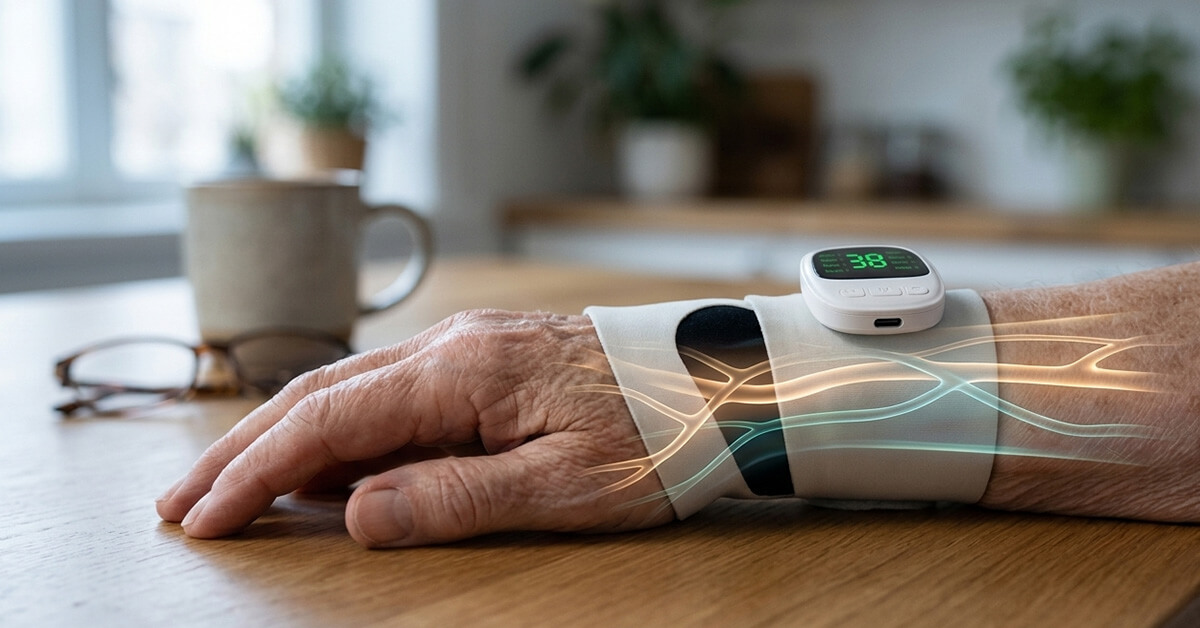
Physical therapists who work specifically with hand and wrist conditions have known for a long time what general advice tends to miss: the wrist needs active therapy, not just passive waiting.
Vibration therapy, specifically, has been used in rehabilitation settings for years. The principle is straightforward. Targeted vibration creates rapid micro-movements in the tissue that the body interprets as stimulation rather than strain. It increases local blood flow. It helps loosen adhesions in tight connective tissue. It activates nerve pathways in a way that can interrupt the cycle of chronic pain signaling — the loop where pain causes tension and tension causes more pain.
Combined with compression — gentle, consistent pressure that supports the joint while promoting circulation — the effect is meaningfully different from anything a brace or an ice pack can deliver.
The challenge has always been access. Vibration therapy used to mean appointments, waiting rooms, insurance paperwork, and the energy it takes to get yourself to a clinic twice a week when your wrist already hurts. For most seniors, that's a serious barrier. Many simply give up before they ever find out whether it would have helped.

What Happens When You Bring That Therapy Home
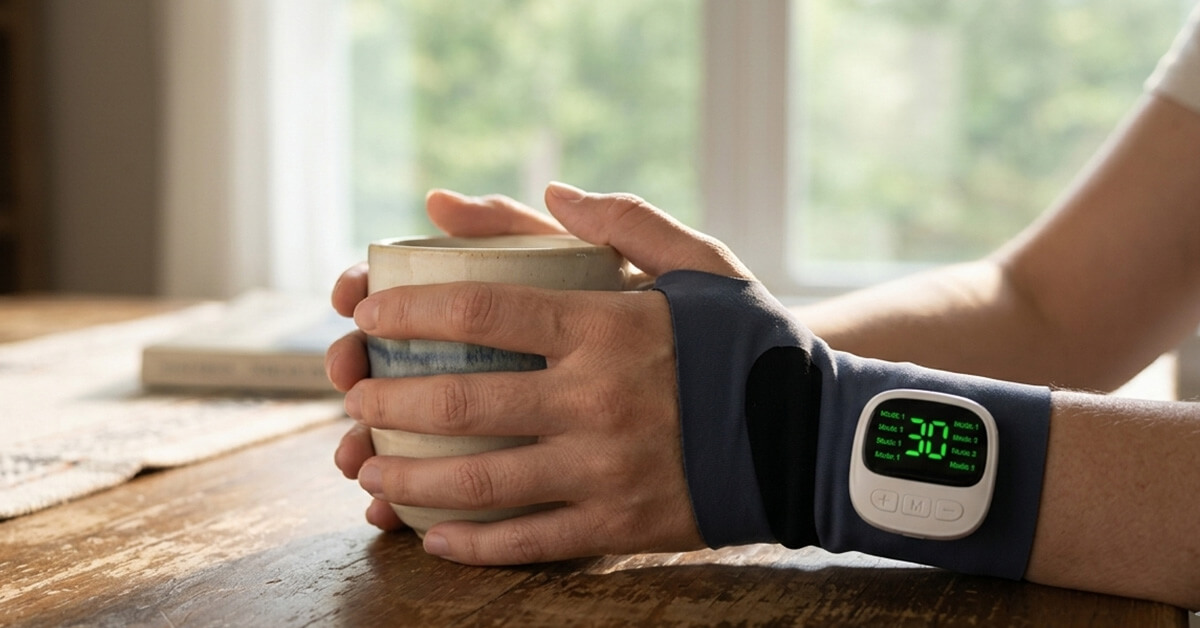
The GripRelief Pro was designed around a simple premise: the kind of relief that used to require a clinical setting should be available on the couch, at the kitchen table, during a morning coffee.
It wraps around the wrist like a soft, flexible sleeve — nothing rigid, nothing that locks your joint in place the way a traditional brace does. Inside, a quiet vibration motor delivers consistent stimulation to the tissue and nerve pathways that chronic wrist pain tends to affect most. The adjustable strap lets you control how much compression you're applying, so you can dial in a fit that feels supportive without feeling restrictive.
The cordless design is more significant than it might seem. One of the reasons traditional wrist therapy gets abandoned is inconvenience — the cord in the wrong place, the device that has to stay on a nightstand, the treatment that becomes another chore. When relief is wireless and wearable, it gets used. And consistent use is where results actually come from.
People who've made it part of their daily routine describe a gradual shift — not a dramatic overnight change, but a cumulative loosening. The stiffness that was the first thing they felt every morning starts to ease earlier. The ache that would spike after an hour of reading or typing becomes less predictable, then less frequent, then something they notice is simply not there the way it used to be.

"I Didn't Realize How Much I'd Been Compensating Until I Stopped Having To"
One of the most telling things people say after finding real relief from wrist pain isn't about the pain itself. It's about everything that changed around it.
The way they'd unconsciously started using their other hand for everything. The hobbies they'd been quietly stepping back from — the knitting basket pushed to the back of the closet, the piano untouched for a season, the grandchild they'd been hesitant to hold for long stretches. The morning stiffness they'd begun factoring into how long it would take them to get ready.
Chronic pain doesn't just hurt. It reorganizes your life in ways you barely notice until the pain is gone and the reorganization is suddenly visible. Small compensations compound. Habits form around the limitation. And what started as a wrist problem quietly starts shaping how much you do, who you see, and what you believe is still possible for you.
The people who break out of that cycle consistently say the same thing: they wished they hadn't waited as long as they did to try something different from the advice that wasn't working.

Why This Particular Moment Matters
If you've been managing wrist pain by resting, bracing, and waiting — and the waiting hasn't produced the results you were hoping for — that pattern is worth disrupting.
Not because rest is the wrong instinct, but because rest alone was never going to be enough for what's actually going on in tissue that needs active stimulation to recover properly.
The window where early intervention makes the biggest difference doesn't stay open indefinitely. Chronic pain that's been in place for months or years becomes increasingly woven into the body's baseline — harder to shift, slower to respond, more likely to become the permanent background noise of daily life rather than something that improves.
Starting something different now isn't impatience. It's the opposite — it's recognizing that the most patient strategy isn't continuing to wait. It's giving your wrists what they've actually been asking for.
First-Time Buyers: GripRelief Pro Is Currently 50% Off
For anyone trying GripRelief Pro for the first time, it's currently available at 50% off the regular price — no code needed, no complicated steps. The discount applies automatically at checkout.
Given that stock at this price is limited and the offer can be pulled at any time, if you've been on the fence, now is the practical moment to move forward.
Your wrists have been waiting long enough.
Click the link above to see if GripRelief Pro is still offering a 50% off discount.