A plain guide to what does and doesn't reduce the appearance of dimpling — and the home device that runs both mechanisms without an appointment.
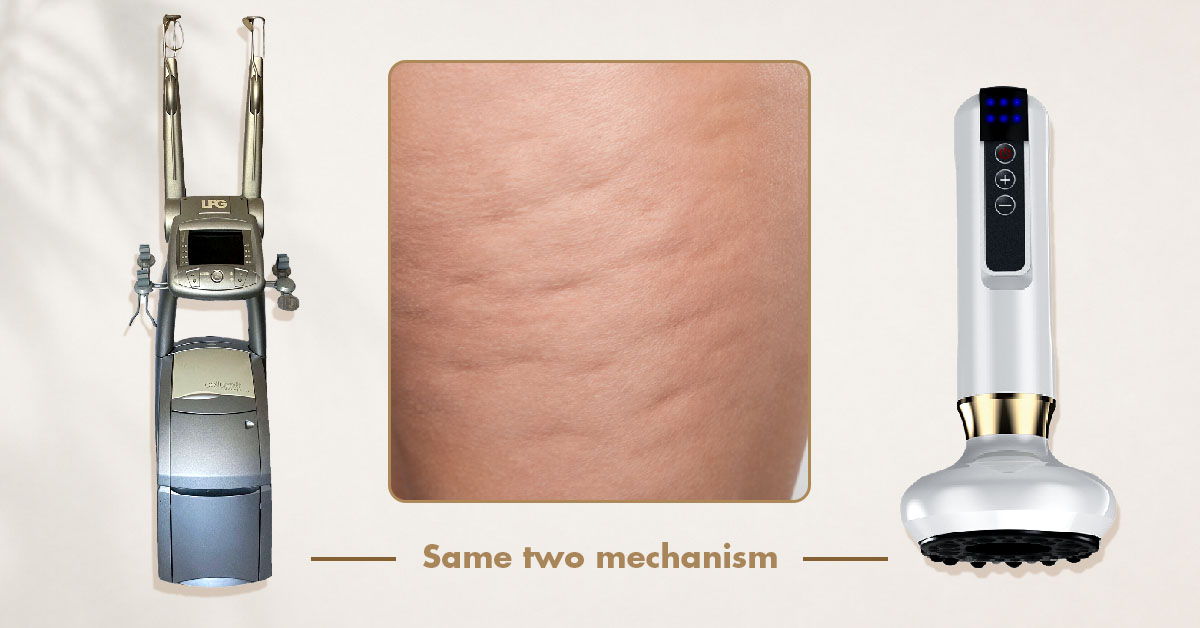
If you have shopped for anything to do with cellulite in the last twenty years, you have been offered roughly forty different mechanisms — caffeine, retinol, dry brushing, cupping, fascia release, radiofrequency, ultrasound, acoustic wave, red light, lymphatic drainage, coffee scrubs, seaweed wraps.
Most of them do very little. Two of them do most of the work, and they have done since the 1980s.
This is a plain guide to which two, why, and what it costs to get them at home rather than by appointment.
First, what dimpling actually is
Worth thirty seconds, because it explains everything that follows.
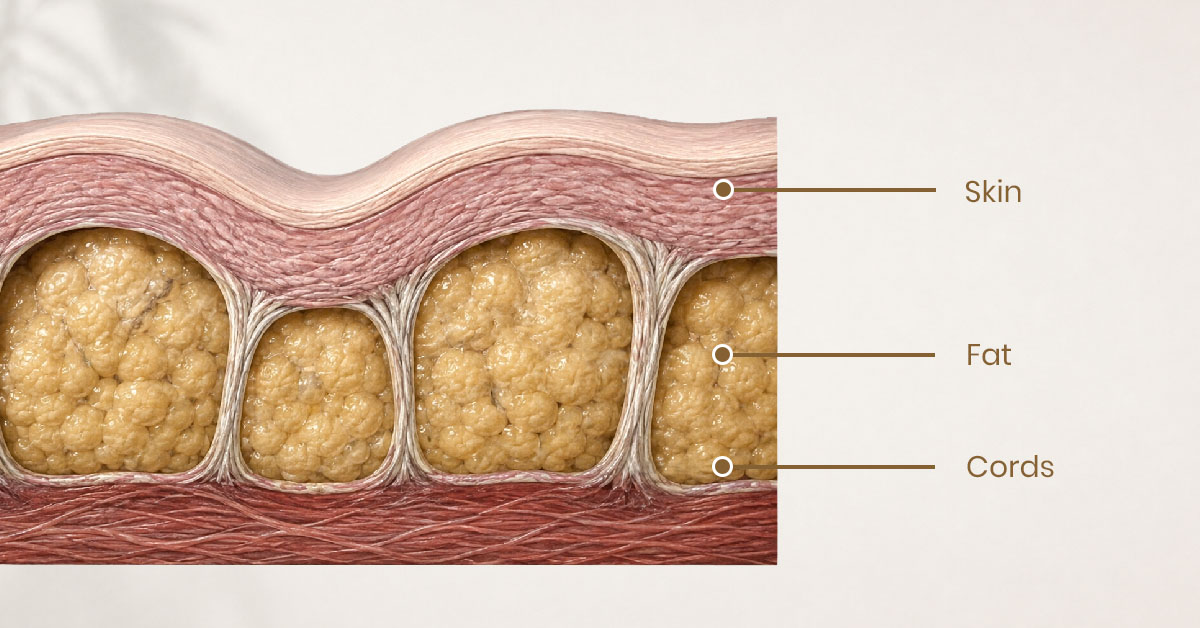
Cellulite is not a fat problem in the way it is usually sold. It is a tethering problem. Fibrous cords run from deeper tissue up to the underside of your skin, anchoring it down. Fat sits in compartments between those anchor points. When the skin above is thick and elastic, it holds smooth across the cords. When it thins — which it does steadily from the mid-forties as collagen production falls — it starts to be pulled down at each anchor while the fat between pushes up.
That is a dimple. It is a structural relationship between three things: the cords, the fat, and the thickness and quality of the skin over the top.
This is why a great many popular approaches cannot work. They are aimed at the wrong element.
What doesn't work, and why
Creams and serums. A topical works on the outermost fraction of a millimetre. The structure causing the dimple sits several millimetres down. Caffeine can produce a brief tightening by drawing out surface water; it is gone by lunchtime. This is why the tube in your cabinet is three-quarters full.
Weight loss. Reduces the fat in the compartments but does nothing to the cords or the skin. Lean and athletic women have cellulite. In some cases dimpling looks slightly more pronounced after significant weight loss, because there is less volume filling the skin from beneath.
Massage guns. A category error. Percussive devices vibrate tissue. Vibrating a tethered dimple does not release it. Excellent for sore muscles, structurally unrelated to this.
Dry brushing. Pleasant, briefly improves surface circulation, does not reach the layer in question.
Manual cupping sets. Right mechanism, wrong implementation — more on this below.
The two that do work
Every professional treatment with real evidence behind it comes back to one or both of these.
1. Lifting the skin away from the cords
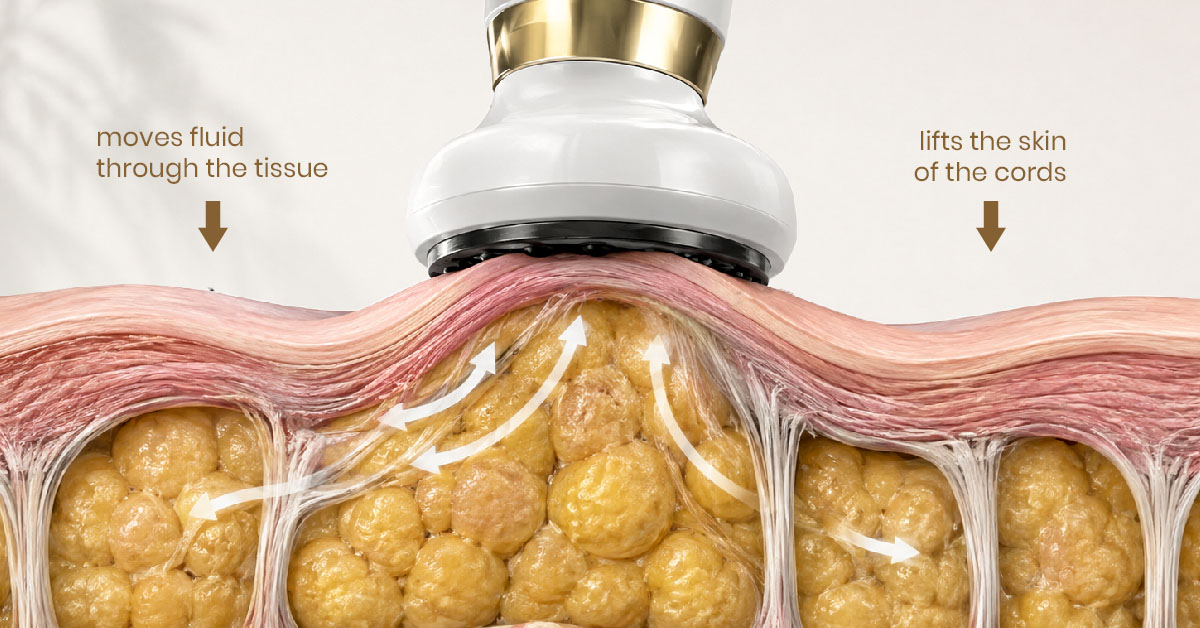
Everything in ordinary life presses skin downward — gravity, sitting, clothing, your own hands. Suction is the only thing that pulls it the other way, placing the tethering cords under a tension they otherwise never experience.
This is the core of endermologie, used in European clinics since the 1980s and still the most established non-surgical approach to the appearance of cellulite. At the surgical end, procedures like Cellfina take the same logic further and physically cut the cords; its pivotal study held up well over two years, at $3,000 and upward.
2. Moving fluid through the tissue
Circulation to the thighs and hips declines with age. Fluid lingers, tissue becomes puffier and less resilient, and the dimpling reads more sharply. Mechanical massage moves that fluid on.
A review of the published research in 2016 found that vacuum massage improved tissue hardness and skin elasticity, and increased fibroblasts and collagen fibres — fibroblasts being the cells that manufacture collagen.
Suction and massage together is, essentially, the whole apparatus of a clinic session. Sessions run $75 to $150 and a standard course is ten or more.
Why the home versions have mostly failed
The mechanism has been available cheaply for years. Silicone cupping sets cost under $20. They rarely get used past a fortnight, for reasons that have nothing to do with whether the method works:
- The seal breaks. You squeeze the cup, place it, then drag it across oiled skin one-handed. It releases constantly.
- There is no adjustment. Suction strength is whatever your grip produced — too weak to matter, or strong enough to bruise.
- You cannot reach. The area that bothers most women is the back of the upper thigh, which requires generating pressure through a rotated shoulder behind your own body. It cannot be done well and it is exhausting inside two minutes.
A powered handset removes all three problems. It generates and holds its own suction at a level you select, maintains it regardless of your grip or angle, and you position it rather than power it.
What DermaFit is
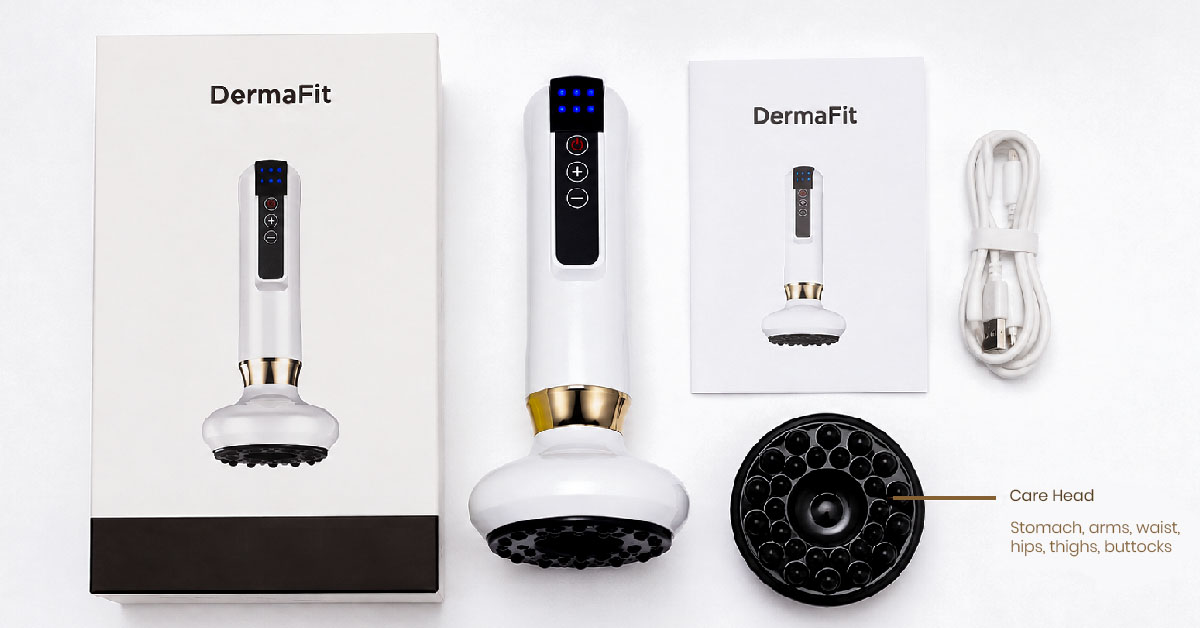
A cordless handset running the same two mechanisms — adjustable vacuum suction combined with massage — plus two adjuncts:
- Red light at 660nm, the wavelength range used in dermatology for collagen stimulation. A supporting mechanism, not the main one.
- Gentle infrared warming, which raises local blood flow and makes tissue more pliable before the suction works.
Suction is adjustable across 12 levels from 1, with 6 interchangeable heads for different areas. Rechargeable, 6 hours per charge.
It is not a clinical device and it is not equivalent to a surgical procedure. It is the two mechanisms that do the work, in a form you can use as often as you like.
The honest timeline
We are not going to tell you this works in twenty days. It doesn't, and anyone quoting that number is counting on their return window closing before you find out.
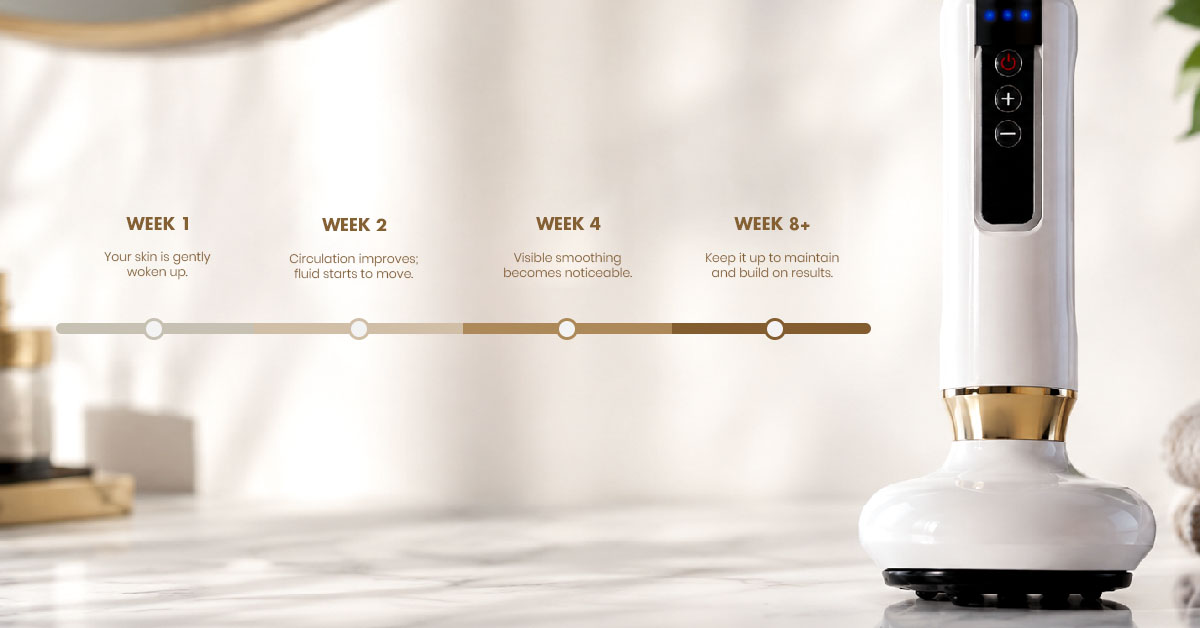
- First few sessions: legs feel lighter, especially by evening. That is fluid moving — real, but not yet a change in your skin.
- Weeks 2 to 3: skin feels softer and more supple. Mild redness after a session is normal and settles within an hour or two.
- Weeks 4 to 8: where visible smoothing typically begins, at roughly ten minutes per area, three to five times a week.
- After that: maintenance, exactly as with a clinic course. Stop entirely and the appearance gradually returns.
Who this isn't for
If you take blood thinners, or have varicose veins, a clotting disorder, lymphoedema, or are being treated for any circulatory condition, speak to your doctor before using suction on your legs. Not boilerplate — vacuum devices meaningfully raise bruising risk on anticoagulants.
Also not for use on the face or neck, over broken skin, or during pregnancy.
And a general note: it should not hurt. A drawing sensation and warmth, yes. Pain, no. If it hurts, the suction is too high. Harder is not faster here — aggressive suction damages capillaries. Start at the lowest setting.
Common questions
Can I use it on the backs of my thighs by myself? Yes — this is the main practical advantage over manual tools. The device holds its own suction, so no grip strength or awkward leverage is required.
Will it bruise me? Not at appropriate settings with oil. Bruising comes from excessive suction, dry skin, or holding the head still in one place. Keep it moving.
Does it work on stretch marks? The red light and improved circulation may improve skin texture over time. We would not lead you to expect stretch marks to disappear.
Do I have to keep using it? Yes, at a reduced frequency. Same as a clinic course — the underlying structure hasn't been permanently altered.
Can I use it on my stomach or arms? Yes. Thighs, buttocks, hips, stomach, upper arms. Not face or neck.
How long is each session? Around ten minutes per area, three to five times a week.
Where it sits on cost
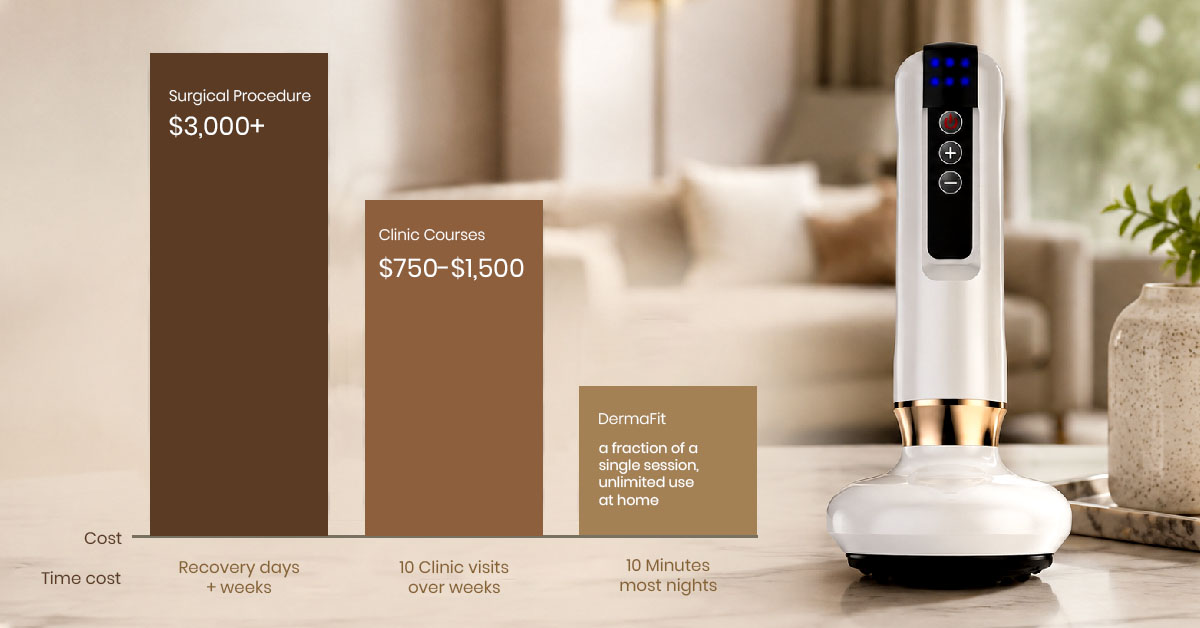
A clinic course at $75 to $150 a session across ten appointments comes to $750 to $1,500, plus the driving and the scheduling. Surgical options start around $3,000.
DermaFit is a fraction of that, paid once rather than per session.
If you want to try it
DermaFit is running a one-time 50% discount for first-time buyers — one per customer, first order only.
Worth being plain about why. Most women reading this have bought something for their cellulite before and been disappointed, so the obstacle is not really price, it is the reasonable suspicion that this is another one. The discount lowers the cost of finding out. With the 30 day return window, the practical downside of testing it is close to nothing.
Click the link above to see if DermaFit is still offering a 50% off discount.