The dimpling is real, the method you tried on it was right, and the tool you were sold required a grip strength and a shoulder rotation almost nobody actually has.
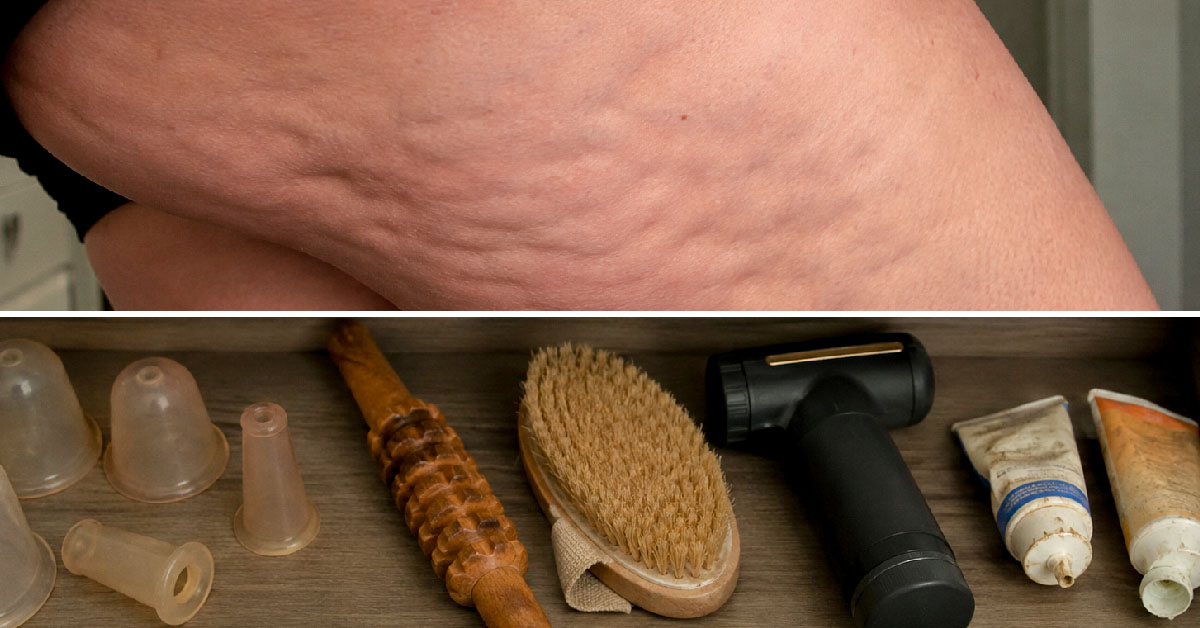
You know the exact patch.
Back of the upper thigh, just below where you sit. It shows in daylight, it shows worse when you sit down, and somewhere in the last few years it stopped being something you only noticed when you pressed on it.
You have tried things on it.
Somewhere in your bathroom there is a drawer, and in that drawer there is a cupping set. Possibly a wooden roller. Maybe a dry brush, a massage gun, a tube of something with caffeine in it that cost more than it should have. You bought each of these in good faith, aimed each of them at that exact patch, used each for somewhere between four days and three weeks, and then stopped.
Here is the part most women get wrong about that drawer: you have almost certainly concluded it is evidence about you. That you didn't stick with it. That you never do.
The drawer is not evidence about you. It is evidence about the tools — and specifically about the fact that not one of them was built for the part of your body you were trying to use it on.
Start with what you got right
The instinct that led you to buy a cupping set in the first place was sound, and it is worth saying so clearly, because you have probably spent years assuming it wasn't.
Suction and mechanical massage is the most established professional approach to the appearance of cellulite that exists. It has been used in European clinics since the 1980s under the name endermologie. A review of the published research in 2016 found that vacuum massage improved tissue hardness and skin elasticity, and increased fibroblasts and collagen fibres — the cells that build collagen and the fibres they build.
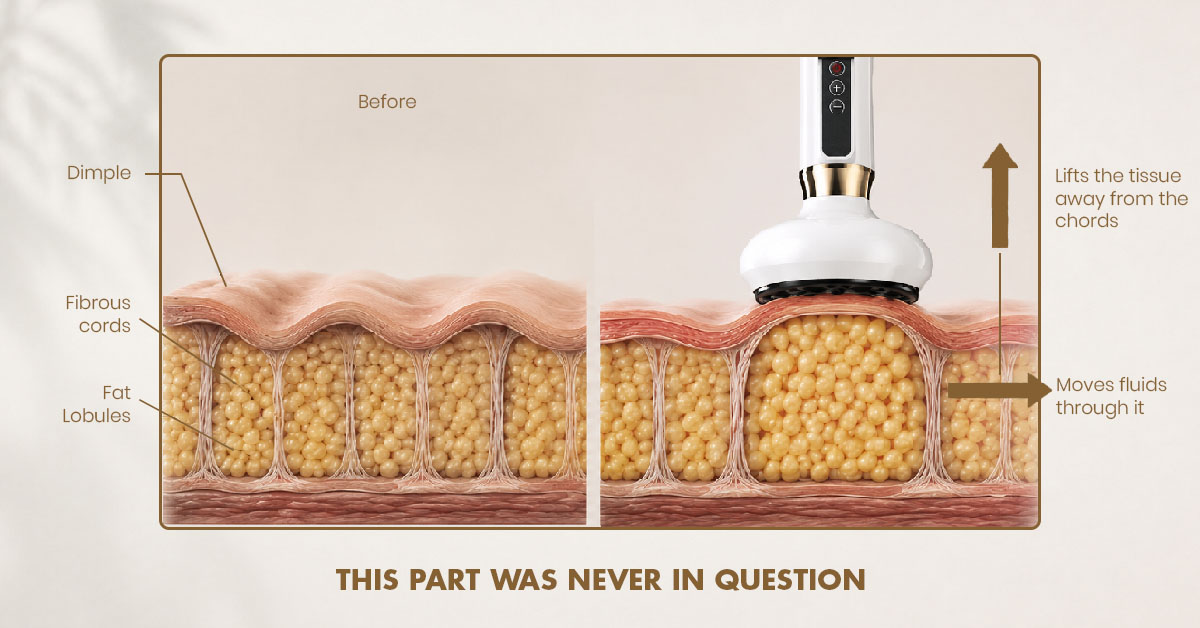
The mechanism is not in dispute and it is not exotic. Dimpling appears where fibrous cords tether the skin down and fat pushes up between them, in tissue where circulation has slowed and fluid lingers. Suction lifts a fold of skin away from the tissue beneath it, putting those cords under a tension that nothing else in daily life produces — everything else presses skin down, this lifts it up. The massage that follows moves the fluid through.
You worked that out on your own, from a magazine or a friend or half an hour of reading, and you bought the tool that was available to you.
The tool was the problem.
What actually went wrong, tool by tool
The silicone cupping set. These require you to squeeze the cup, place it, and maintain a seal while dragging it across oiled skin — one-handed, at an angle, on a part of your body you cannot see. The seal breaks constantly. When it doesn't break, the suction is fixed at whatever strength your grip produced, which is either too weak to do anything or strong enough to leave a mark. There is no adjustment. There is no consistency. Two sessions in, you have a bruise on your thigh and no idea whether you did it right.
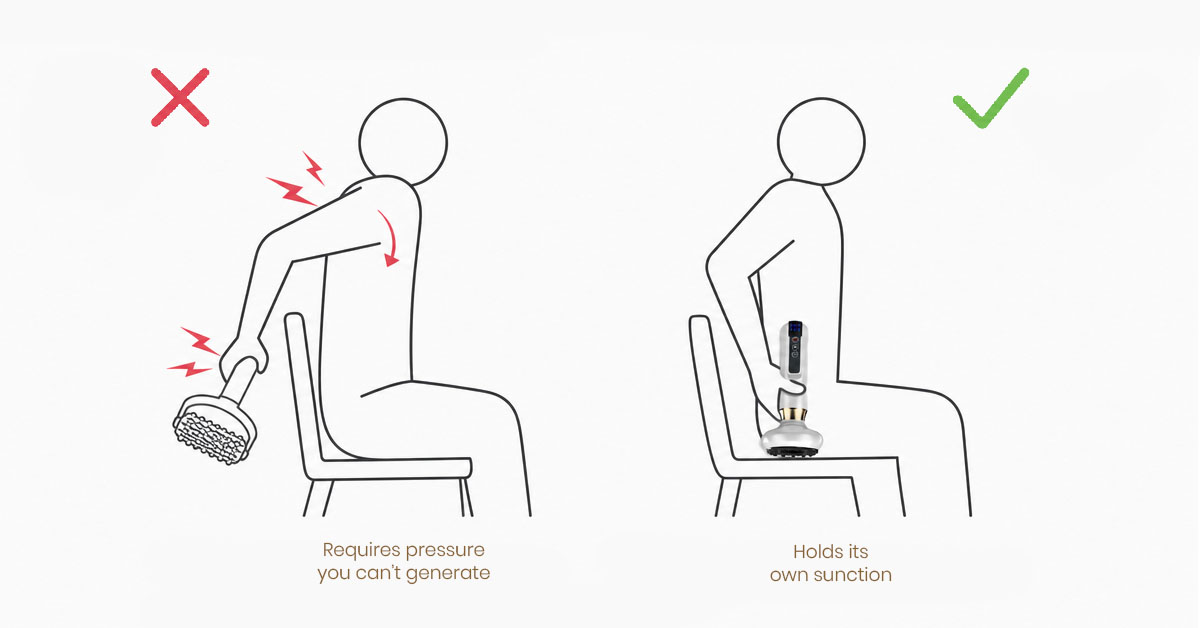
The wooden roller. A roller only works with pressure, and the pressure has to come from your arms. On the front of the thigh, fine. On the back of the upper thigh — which is the area that actually bothers you — you are attempting to generate meaningful downward force through a rotated shoulder, behind your own body, with no leverage. It cannot be done well. It is exhausting after ninety seconds.
The aggressive fascia tools. The ones marketed with instructions to push hard and expect bruising. A great many women tried these, hurt themselves, and quietly concluded that the entire category was nonsense. Understandable. But harder is not better here — aggressive pressure damages capillaries, and gentle consistent suction moves fluid more effectively than force ever will.
The massage gun. This one is a category error rather than an execution failure. Percussive therapy vibrates tissue. It does not lift it. For sore muscles it is excellent. For the appearance of dimpling it is doing something structurally unrelated to what the clinics do.
The dry brush. Pleasant. Improves circulation at the surface briefly. Works on the outermost fraction of a millimetre of a problem that sits several millimetres down.
The thing they all have in common
Every one of those tools required you to supply the force.
Grip strength to hold a seal. Shoulder rotation to reach behind yourself. Sustained pressure through an arm at an awkward angle, for ten minutes, three times a week, indefinitely.
Those are real physical demands, and they are demands that get harder rather than easier from the mid-forties onward. Nobody selling a $19 cupping set mentions this. So when you stopped after eleven days, the explanation available to you was that you lack discipline — rather than that you had been handed a tool that required capabilities it never disclosed.
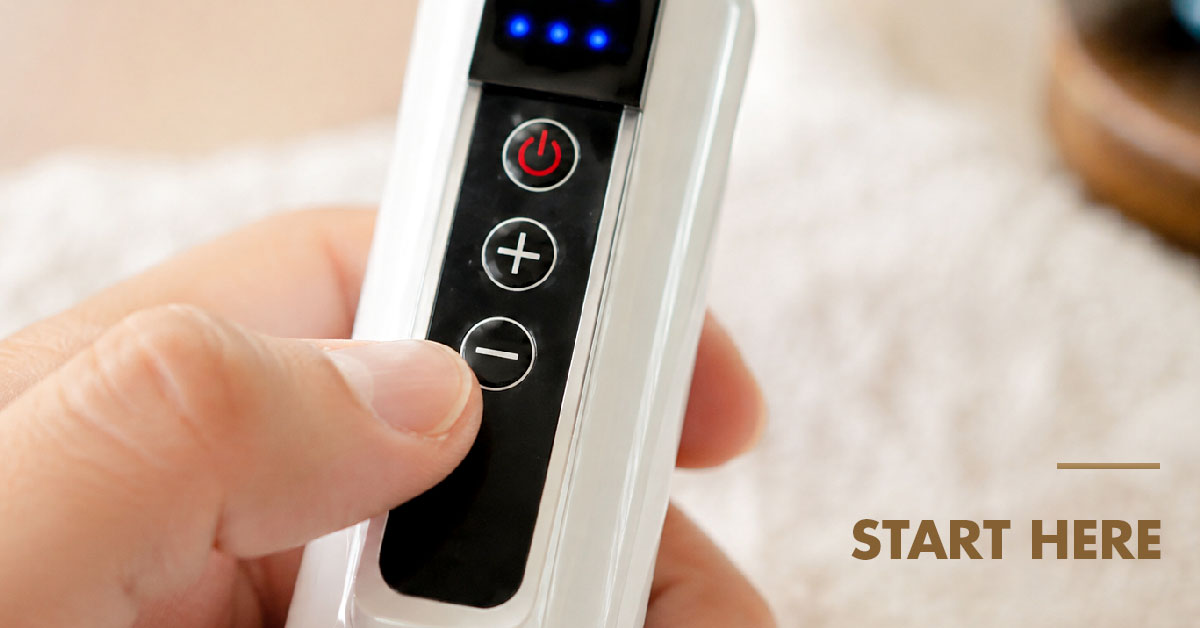
A powered handset removes that requirement entirely. The device generates and holds its own suction at a level you select and it maintains that level whether your grip is firm or not, whether your arm is at a good angle or not. You are positioning it, not powering it.
Which is the difference between a method you believe in and a method you can actually perform, sitting on the edge of the sofa, most nights, for the eight weeks it takes to see anything.
The honest timeline
We are not going to tell you this works in twenty days. It doesn't, and the sellers quoting that number are relying on their return window closing before you find out.
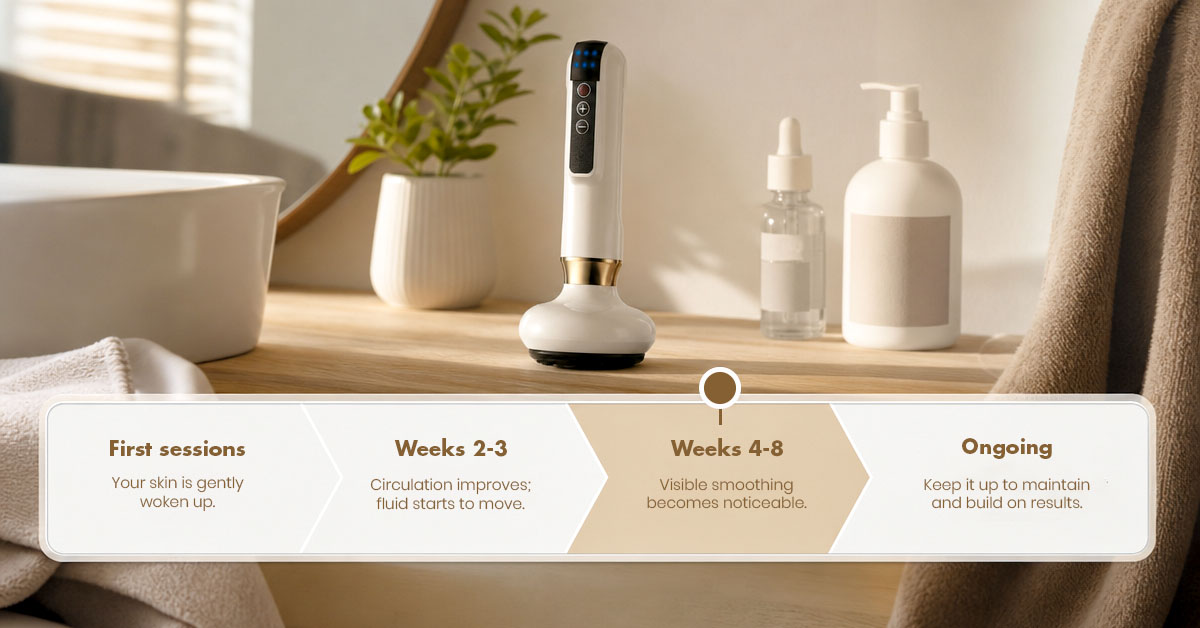
- First few sessions: legs feel lighter, particularly in the evening. That is fluid moving. It is real, and it is not yet a change in your skin.
- Weeks 2 to 3: skin feels softer and more supple. Mild redness after a session is normal and settles within an hour or two.
- Weeks 4 to 8: where visible smoothing typically begins to show, with roughly ten minutes per area, three to five times a week.
- After that: maintenance, exactly as with a clinic course. Stop entirely and the appearance gradually returns.
That is slower than this category usually promises. It is what the evidence actually supports, and it is the timeline every one of your abandoned tools would also have needed — which is worth sitting with, because none of them gave you eight weeks of comfortable use to find out.
Before you buy another one
Fair warnings, given the drawer.
It should not hurt. A drawing sensation and warmth, yes. Pain, no. If it hurts, the suction is too high — turn it down. This is the single most common reason people give up, and it is entirely avoidable.
Use oil. The head needs to glide. Any body oil works. Dragging on dry skin is what causes marks.
If you take blood thinners, or have varicose veins, a clotting disorder, lymphoedema, or are being treated for any circulatory condition, talk to your doctor before using suction on your legs. This is not boilerplate. Vacuum devices raise bruising risk meaningfully for anyone on anticoagulants.
Not for the face, neck, or over broken skin.
Where this sits
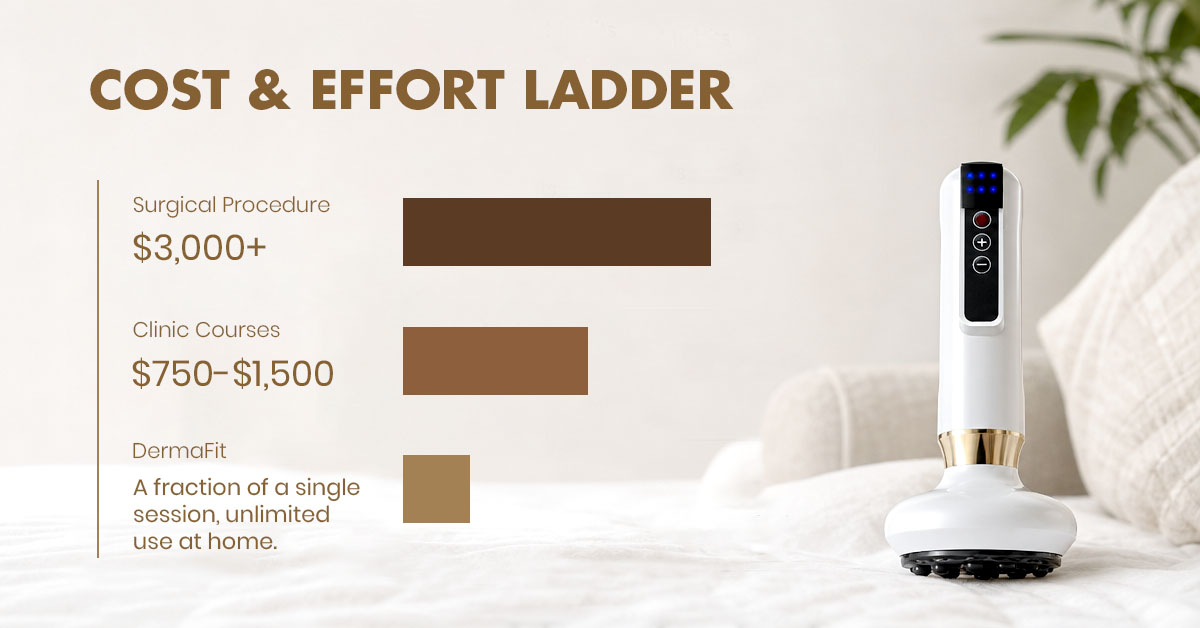
A course of clinic endermologie runs $75 to $150 a session across ten or more appointments. At the surgical end, procedures like Cellfina — which physically cuts the tethering bands and held up well over two years in its pivotal study — start around $3,000.
DermaFit is a fraction of that, paid once rather than per session, and it asks nothing of your grip or your shoulders.
It is not equivalent to a surgical procedure and we would not claim otherwise. It is the method you already believed in, in a form you can actually keep up.
If you want to try it
Vysta Health is running a one-time 50% discount for first-time buyers — one per customer, first order only.
Given the drawer, it is worth being plain about why. The obstacle here is not really price. It is that you have bought something for this before and it went badly, and a reasonable person does not want to be wrong about the same thing twice. The discount exists to make finding out cheaper. With the 30 days return window, the practical downside of testing it is close to nothing — which is about where you should be before spending anything on a category that has already disappointed you.
Click the link above to see if DermaFit is still offering a 50% off discount.